Born in the small town of Apex, North Carolina, in 1895, Kyle Monroe Yates became one of this country’s preeminent Biblical scholars, an Old Testament specialist, a member of the elite group of scholars who translated the Revised Standard Version of the Bible, author of the most widely respected textbooks on the Hebrew language plus numerous volumes on preaching from the Bible for ministers, a leader in the Southern Baptist Convention, a preacher of highest reputation, Biblical consultant to Cecil B. DeMille during the making of the classic film The Ten Commandments, and a Distinguished Professor of Bible at Baylor University.
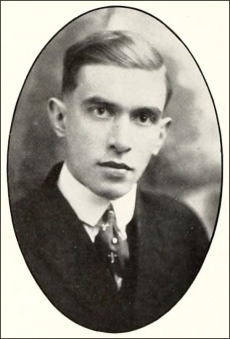
Kyle Monroe Yates
Th.D., Ph.D., D.D., LL.D., Litt.D.
Pastor, Theologian, Scholar
“True instruction was in his mouth,
and no wrong was found on his lips.
He walked with me in peace and uprightness,
and he turned many from iniquity.”
(Malachi 2:6, Revised Standard Version)
A biographical monograph (abridged)
by Dr. Grover B. Proctor, Jr.
© 2012, 2015, 2017

As noted in the title of this monograph, Dr. Kyle Yates was best known to the world as a pastor, a theologian, and a scholar. And there is no question that he was nationally renowned for his extremely high levels of contribution and service to each. He did all of this, in an 80-year lifespan, while maintaining a gentleness, benevolence, empathy, humility, and deep Christian love for all those with whom he came in contact.
One former student of his at Baylor University, in a book called People Sharing Jesus, said Dr. Yates was “one of the kindest, most gracious men I have ever known.” Another former student unequivocally called him “Statesman, scholar, and stimulator!” – describing Dr. Yates walking into class the first day as a man “with such poise and dignity that I wanted to stand and welcome him. His tall stature, flowing gray hair, and radiant smile captured me immediately. If I were to paint a picture of a president or world statesman, it would be this man.” This same former student suggested that the verse from Malachi (which forms a part of the title section above) truly describes Dr. Yates.
EDUCATION
Kyle Yates was born February 7, 1895, in Apex, North Carolina, the first of eleven children of William Charles Manly Yates and Della (Jones) Yates. His education began with a diploma from Campbell College in Buies Creek, NC, in 1911, after which he graduated from Wake Forest College with an A.B. degree in 1916 and an A.M. degree in 1917, working as a farm hand to pay his way through school. At Wake Forest, he was a star on the school’s basketball team that that still boasts the “most successful season in the history of the college.” Yates’ Senior portrait, from that 89% winning-percentage season, is shown above in the title section.
His education continued at Southern Baptist Theological Seminary, in Louisville, Kentucky, where he received both a Master’s (Th.M.) degree in 1920 and a Doctorate (Th.D.) in 1922. His doctoral Thesis at the Seminary was titled The Prophetic Movement in Israel, and he would go on to become one of the world’s most widely acknowledged and leading experts in the Old Testament in general, and specifically in the Prophets. After completion of his doctorate, he joined the faculty of Southern Baptist Seminary as a Professor of Old Testament.
While he was on faculty there, he took a sabbatical year and went to the University of Edinburgh in Scotland, where he earned a Ph.D. degree in 1932, writing a Dissertation on the Aramaic and Greek languages. In addition to further study he undertook at Princeton University, during his distinguished career he was awarded honorary doctorates from Baylor, Wake Forest, Union, and Mercer Universities. He was expert and fluent in Hebrew, Greek, Aramaic and Latin.
“A WOMAN OF UNDERSTANDING AND DISCERNMENT”
Early on during his time on faculty at Southern Baptist Seminary, Yates courted and married a former student of his, Miss Margaret Webb Sharp from Clinton, Mississippi. They were married until Dr. Yates’ death 53 years later, during which time Margaret Yates was acknowledged as a woman of “understanding and discernment … of great charm, reared in the tradition of the Old South” and one of “the great ladies.”
Yates showed his total love and affection for his wife by the references he repeatedly made to her (in class and elsewhere) as his “little bride,” his “princess,” his “little one,” and “a sweet little thing that keeps in me in line.” The two seemed inseparable throughout their lives together. She routinely joined him on the golf course and on his transcontinental auto tours.
Dr. Yates summed up his devotion to and love for his wife when he dedicated his 1948 book Preaching from the Psalms to her:
DEDICATED
To
MY WIFE
a devoted lover
a treasured helper
a constant inspiration
a consecrated Christian
Margaret Yates died on August 8, 1987, at the age of 91.
ACADEMIC, AUTHOR, AND SCHOLAR
It was during his twenty years on faculty at Southern Baptist Seminary that Yates began his second career as an author. “In response to the need for an introductory Hebrew grammar,” the Seminary wrote in its remembrance of Yates, “he prepared and published The Essentials of Biblical Hebrew which soon won for itself wide recognition. In 1938 it was revised and enlarged, particularly in its treatment of Hebrew syntax.” It came to be among the most widely used and well respected books in this field, in use for multiple decades at both Christian Seminaries and in Jewish rabbinical schools.
In addition to the above, he was sole or co-author of many books, some of which became classics in the field. Among these were:
● Beginner’s Grammar of the Hebrew Old Testament, 1927
● From Solomon to Malachi, 1934
● The Essentials of Biblical Hebrew, 1938
● Preaching from the Prophets, 1942
● Old Testament Biographies, 1942 (co-author)
● Preaching from the Psalms, 1948
● Studies in Psalms, 1953
● Preaching from Great Bible Chapters, 1957
● Preaching from John’s Gospel, 1964
● Psalms of Joy and Faith, 1973; reprint, 1984
So profound was the impact of Dr. Yates’ two books on the Hebrew language, Beginner’s Grammar and The Essentials, that it became known throughout the world of scholarship as the standard for teaching Old Testament Hebrew. A strong but highly unusual recognition of Yates’ book’s approbation appeared in the mid-1950s in a learned monograph on the Hebrew language. A contemporaneous press account of this stated, “I know of no other Baptist preacher’s name that has appeared in this sophisticated journal of the intelligentsia with the exception of Billy Graham’s.”
By the time of his retirement, his book Preaching from the Prophets had gone through 27 editions. His Preaching from the Psalms, later reissued with the title Psalms of Joy and Faith, was dictated onto tapes while he was on a brief vacation in Palacios, Texas, and within 31 days of its publication it had sold 250,000 copies.


The aim of The Bible from 26 Translations is to combine in one volume the complete KJV and the most significant variations from 25 later translations. Here is Psalm 23:1-2.
THE REVISED STANDARD VERSION
While being known for being “slow to list his many accomplishments over the years,” Yates always acknowledged that his proudest achievement was being selected as one of the nine original scholars commissioned to translate and prepare what would become known as the Revised Standard Version of the Bible (RSV), a project that ran from 1938 to 1952. The RSV Bible was a modernization of the American Standard Version (ASV, 1901), which was an updating of the Authorized (King James) Version (AV or KJV, 1611). The RSV has itself been modernized by both the New Revised Standard Version (NRSV, 1989) and the English Standard Version (ESV, 2001).
Yates’ leadership role in this endeavor puts him inside the highest levels of the English language Bible tradition, and he participated in several other scholarly Biblical publishing projects. He was one of the 40 theologians who collaborated on the Wycliffe Bible Commentary, published in 1962, for which he wrote the entire commentary on the book of Genesis. Dr. Yates also served as a “Contributing Editor for the Old Testament” for the mammoth 2,592-page The Bible from 26 Translations, which began to be published in sections in 1967, and then all together in one volume in 1988. It is still in print today from Mathis Publishing, under the title The WORD: The Bible From 26 Translations.
INTO THE PULPIT
During all of his time at Southern Seminary, he always had a strong ministerial focus. When he decided to leave there in 1942 to enter into the full-time pastoral work at Louisville’s Walnut Street Baptist Church, the Seminary recommended him highly: “His friendly approach will reach to all members of his great congregation and beyond in his pastoral ministry. His understanding of people and his ability as a public speaker will give to his preaching a powerful popular appeal. His long study in the field of Biblical interpretation will give to his message a solid content and educational value. And the evangelistic note in all his preaching will carry on the fine tradition of the great evangelistic church.” Yates’ tenure at Walnut Street, described as “Kentucky’s largest congregation,” lasted four years.
In 1945, when Yates was 50 years old, he received a telephone call one Sunday afternoon from Federal Judge T. M. Kennerly, chairman of the Pulpit Committee of Second Baptist Church in Houston, delivering the church’s call to become their new pastor. More than 2000 parishioners attended the morning service that day, and the vote to call Dr. Yates was described as spontaneous and with one accord. The Pulpit Committee had considered more than 50 people for the position, but they ultimately selected Yates, whom they described as “God’s man.”
Judge Kennerly spent 30 minutes of expensive long distance time, in an effort to convince Yates to accept the congregation’s call to become their pastor. “I remember telling him I saw no reason to give up my pastorate in Louisville,” Dr. Yates recalled. “But his response was, ‘The only reason, my boy, is that you should follow the will of the Lord.’” He was on a plane to Houston for meetings on Thursday and Friday of that week, and was reportedly back in Louisville the following Sunday, announcing his resignation.
Yates spent the next ten years at Second Baptist. When Dr. Yates announced his intention to resign in order to move to Baylor University in Waco to resume his academic career, it was “in the face of a standing ovation of 1,000 church members to a resolution asking him to stay in the Houston church.”
A press account at the time of Dr. Yates’ resignation from Second Baptist Church noted his “urban graces” and reminisced that “his church will miss his preaching, a masterly amalgam of profound scholarship and simplicity, that edified adults and fascinated children. They will miss his warm greeting and handshake at the end of the services. He had invested this usually routine procedure with an intimacy that made one forget the pressing crowds from behind.”
While he was the pastor at Second Baptist in Houston, Yates served as the 2nd Vice President of the Southern Baptist Convention in 1956, and later as Vice President for one year.
THE TEN COMMANDMENTS
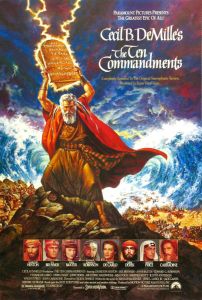
It was not an opportunity that he sought for himself, but Dr. Kyle Yates did make one important and indelible impact on Hollywood. It concerned the making of the classic film The Ten Commandments in 1956. Perhaps the best way to summarize how it all came about is to quote a contemporary press clipping, noting that Yates was
“…consulted by Cecil B. DeMille on the authenticity of certain portions of the motion picture, The Ten Commandments. Dr. Yates happened to be in California last summer when the $9.5 million DeMille picture was nearing completion. When DeMille, who spared no effort or expense to authenticate every detail of this project, learned of Dr. Yates’ presence on the West Coast and of his eminence as a Bible scholar, he immediately contacted the Baylor professor and invited him to lunch…. Dr. Yates reports that it was a most interesting and stimulating experience….
“Dr. Yates’ personal opinion of The Ten Commandments is that ‘It is probably the greatest motion picture that has ever been made.’ He says it is ‘remarkably true to Scriptural and secular history and amazingly free from the flagrant liberties so often taken with such material.’ Commenting on the criticism which many church people have had for the licentiousness of the scene of the reveling people, following Moses’ descent from Mt. Sinai with the tablets of the Law, Dr. Yates says that the DeMille script was not exaggerated. He points out that the Bible is pretty plain in its description of the revelries which took place and that Moses himself was sickened with disgust at what he saw. ‘I consider the whole work a powerful depiction of truth,’ Yates says, adding that he believes that everyone who reads and believes the Old Testament should see the filmed story.”
Dr. Yates would later say that some people thought the movie exaggerated “the high jinks among the Israelites while Moses is on Mount Sinai,” as he put it. He answered them by repeating that the film is no exaggeration — “It’s all in the Bible!” He called the filmmakers’ approach “scholarly” based on “a vast knowledge of fact and detail.”
A DISTINGUISHED PROFESSOR AT BAYLOR UNIVERSITY

In 1956, Yates left the active, full-time ministry in Houston to travel up to Waco, Texas to join the faculty of Baylor University, where he held the rarely accorded rank of “Distinguished Professor.” In moving to Baylor, Dr. Yates said it was not only to enable him to resume his teaching career but also to spend more time on his writing. At that time, he had published six books, including two he had completed in his “Preaching From…” series, to which he hoped to add another four volumes.
In addition to his scholarly research and writing while at Baylor, Yates continued to find avenues of preaching outreach. Among the many honors and awards he received during this time was an Award of Merit presented by the Radio Television Commission of the Southern Baptist Convention, recognizing him “for teaching the International Sunday School lesson on the Baptist Radio Hour every week for two years” to a documented audience of 2 to 5 million people weekly.
For all the scholarly and ministerial opportunities which he tackled with fervor, without doubt it was the Baylor students on whom Yates left his most indelible mark. His courses were consistently among the most popular offered by the Baylor Department of Religion. Students were effusive in their praise, some agreeing that they found it hard to write down all the facts Yates presented in class, because “they weren’t really like facts, but sort of like parts of a simple conversation.” One student called Dr. Yates “the greatest man and the greatest professor I’ve ever met. He knows so much it really scares me because I sometimes think he was there when it all happened.”
One former student recently blogged: “From that first lecture and interchange, I was fascinated with the Bible and the study of it. I could not believe that the Bible could be so alive…. Dr. Yates was one of the most learned men I have ever known. Yet, he was able to reduce all the facts into such a flowing narrative that students felt they were walking in biblical times.” The Independence Baptist Association, when honoring Dr. Yates some years later, noted, “To young and old, rich and poor, he is considerate and courteous to all. He speaks to professor and student alike on the campus. Cafeteria lines halt momentarily for many visits when he goes to lunch.”
As befitting not only Baylor’s Christian commitment but also his own deep-seated faith, Yates always ended his classes with a prayer. He was known to warn the class on certain days, “We may have to cut short so we can spend a bit more time with our prayer. There’s plenty to pray for these days.” While it was not unusual for Baylor religion professors to open or close their classes with a prayer in those years, students soon realized that Yates’ prayers “seemed more like real conversations with God.”
RETIREMENT AND BEYOND
Yates retired from Baylor in 1969 at the venerable age of 74, with the title bestowed on him of Distinguished Professor Emeritus.
On June 11, 1972, Dr. Yates was honored as the Texas Baptist Elder Statesman of the Year, an award presented annually to persons who have rendered long-time distinguished service “to God and Texas Baptists.” At the ceremonies, it was noted that “Biblical scholars have acclaimed Dr. Yates as ‘the world’s authority on the prophets’.”
Just eight days after his eightieth birthday, on Saturday, February 15, 1975, Dr. Yates passed away in a Waco nursing home, as a result of congestive heart failure. He is buried in Oakwood Cemetery in Waco. On Dr. Yates’ tombstone is the Greek word hypernikomen (spelled out in perfect original Greek).

Meaning “to be more than a conqueror,” the word is used only once in the Bible, but it comes from what was Dr. Yates’ most quoted passage, Romans 8:37. As shown in The Bible from 26 Translations, the Greek word hypernikomen has been rendered in various translations as “we more than conquer,” “we keep on gloriously conquering,” and “we win an overwhelming victory.” It is no wonder, then, that this word appears as the lasting memorial of the life and service of Dr. Kyle Yates.
As such, it is fitting to end this tribute to him with the passage as translated in the Revised Standard Version:
Who shall bring any charge against God’s elect? It is God who justifies; who is to condemn?
Is it Christ Jesus, who died, yes, who was raised from the dead, who is at the right hand of God, who indeed intercedes for us?
Who shall separate us from the love of Christ? Shall tribulation, or distress, or persecution, or famine, or nakedness, or peril, or sword?
As it is written,
“For thy sake we are being killed all the day long;
we are regarded as sheep to be slaughtered.” [Psalm 44:22]
No, in all these things we are more than conquerors through him who loved us.
For I am sure that neither death, nor life, nor angels, nor principalities, nor things present, nor things to come, nor powers, nor height, nor depth, nor anything else in all creation, will be able to separate us from the love of God in Christ Jesus our Lord.
(Romans 8:33-39, RSV)
 “We Will Rebuild”
 Lord, we ask for Your mercy on this land.


 Christ Our Passover
‘Truly, before Abraham was…’
• I am the bread of life.
• I am the light of the world.
• I am the door (or gate).
• I am the good shepherd.
• I am the resurrection and the life.
• I am the way, the truth, and the life.
• I am the true vine.
Each of the seven “I AMs” may be found in the Gospel of John, and of course — inescapably and profoundly — Jesus is most certainly each and every one of them. That knowledge is vital in our attempts to more completely understand Him, His earthly Mission, and His plan for our salvation.
That greatest “I AM” is also found in the book of John. In Chapter 8, Jesus is responding to increasingly virulent verbal questioning and accusations from a group of Pharisees (or “the Jews,” as John refers to them). As the replies from Jesus hit closer and closer to home, the Pharisees finally (metaphorically) throw down on the table their ancestral trump card: “We are the descendants of Abraham!” they cried. The implication was clear: “We are Abraham’s offspring! As such we are God’s chosen — and therefore we cannot possibly be guilty of the accusations You are making against us!”
It all comes to a head when Christ tells them that they are far from acting like God’s Chosen People. You are instead, Jesus tells them, “of your father the Devil, and you want to carry out your father’s desires.” Their response to this is the classic playground bully retort, used by those who have no rational, legal, or (in this case) spiritual arguments to fall back on — “Yeah, well if we’re bad, you’re worse!”
I truly believe a strong case can be made that, of all the things Christ is quoted as saying in the Bible, this one statement packs the biggest explosive power. The Pharisees understood perfectly well what He was telling them. They needed no sages, commentaries, or apologists to explain it. But just in case the full meaning is not yet completely clear today, 2000 years later, here is what two highly respected New Testament Commentaries say about Christ’s “I am” statement and its profound message:
[Holman Concise Bible Commentary]
The words rendered “was” and “am” are quite different. The one clause means, “Abraham was brought into being”; the other, “I exist.” The statement therefore is not that Christ came into existence before Abraham did, but that He never came into being at all, but existed before Abraham had a being; in other words, existed before creation, or eternally [John 1:1]. In that sense the Jews plainly understood Him, since “then took they up stones to cast at Him,” just as they had before done when they saw that He made Himself equal with God [John 5:18].
[Commentary Critical and Explanatory on the Whole Bible]
SOURCE: BIBLEHUB.COM
Now, don’t panic. I know you’re eyeing this chart with all the Greek writing in it with trepidation, bordering on fear and loathing. Don’t let your eyes (or your brain) glaze over. Breathe in; breathe out.
Understanding Greek is not in any way a prerequisite for continuing to read this article! I’ve only included this graphic because I want us to fully share and savor the meaning and import of every single word and phrase in Christ’s momentous declaration. Read through the English on the bottom line, and when you are finished, we’ll walk together on a journey through Christ’s amazing declaration.
On first reading, Jesus’ “I AM” statement (bottom line, in brownish-orange on the chart) might seem simple. But then you notice that, strictly speaking, it doesn’t make grammatical sense. (Past tense and present tense, in the same sentence?) By the time we’re finished, however, I hope you’ll agree that Jesus said it perfectly correctly and that it contains an infinitely powerful truth.
Scholars used to be unanimous in believing that Jesus spoke this sentence in the Aramaic language, but more recently (thanks in part to the finds in the Dead Sea Scrolls) some have come around to suggesting Hebrew was the language of dialogue and learning in first-century Judea. Either way, John’s translation of His statement into Greek comprises only 9 words. In order to understand the profundity inherent in the message of those few words, let’s take them word by word (or phrase by phrase) and see how Christ’s one-sentence reply to the Pharisees answered the one largest question about who Jesus was — and at the same time raised a huge number of other questions.
A Walk Through John 8:58. Each of the five large text blocks below tackles one word or phrase from Christ’s sentence. In a box in the upper left of each text block, I have mirrored the Interlinear graphic above, putting John’s actual Greek word(s) on the middle line, the English transliteration on the top line, and the English literal translation at the bottom in red type. *
My commentary, inside each larger text block, attempts to reflect the thoughts that might have rapidly gone through the mind of someone present at the time Jesus had this confrontation with the Pharisees. As such, the phrases and sentences are often fragmented and jump quickly to new considerations. They are also repetitive, as one might go back to a previous thought in order to add a new insight gained and see if total meaning is emerging.
Just read the following in a flow, and with luck and God’s guidance, we’ll trust that His meaning will become clear.
Ἀμὴν ἀμὴν
Truly, truly
Did you know that every time Jesus began a sentence “Truly” or “Verily, verily,” He was using the Hebrew word “Amen”? It’s true. It means “Truth.” (The English equivalents most often given by NT Greek Lexicons for “amen” (pronounced “ahm-AIN”) include truly, verily, surely, certainly, of a truth, it is the truth, and so be it.) Using it to precede a statement of fact or an announcement was a common idiom at the time, indicating not only its veracity but also that it was of some significance. We do a similar thing in English when we start a sentence like this: “I’ll tell you the truth, that was one of the hardest things I’ve ever done!” or “In all honesty, I think his new haircut looks silly.” [We even have a way of doing that in the vernacular (slang) when we start a sentence with “Seriously.” “Seriously, dude, where’s my car?” However, I don’t think I would use it to translate a statement made by Jesus!] That Christ used the word “Amen” twice to begin this sentence signified major emphasis. He was calling attention to the fact that what He was about to say was not only true, but also important. When we get to the end of Christ’s sentence, that will seem like an understatement.
λέγω
I say
Time is important and will play a large role in the meaning of this sentence. We’ve already gotten the message that the sentence is true and important, and now this single simple word communicates both subject and verb — “I say” (or “I am saying”). We can read a clear subtext in this one word: We start with “Truth. Very important.” and we add “Now. In the present. At this moment. As I look at you and you look at me, I SAY this to you. We are locked together in this time of the now. This is not something you heard in the past, and no prophecy of the future has revealed it to you.” Also by this, Jesus takes full responsibility for the unbelievable magnitude of what He is about to tell them.
ὑμῖν
to you
With the addition of this word, Christ’s hearers have been given this introduction: “Truth. Important. Present tense. I am saying… to you.” Still locked eyeball to eyeball, Jesus and the Pharisees have been engaged in a “knock-down, drag-out” verbal battle, and He has just heard the Pharisees play their ancestral “trump card” — “We are the descendants of Abraham! We are the spiritual Leaders of God’s Chosen People! And who are you? You are one of the hated, heretical Samaritans and are clearly demon-possessed!” The carpenter’s son from Nazareth — the Creator of the Universe — looks at them calmly and assures them that this “truth,” this “important truth,” is specifically for them. They will have to deal with its ramifications.
πρὶν Ἀβραὰμ γενέσθαι
Before Abraham was [born]
Jesus now makes time move within a single sentence. He started with the present tense: “Truth. Important. I am saying this now to you.” But He immediately reverses gear and casts them back to the ancient past: “What I am saying to you, the message I have for you, carries implications about and derives its authority from — the past.” In telling the Pharisees just before this that “Your father Abraham was overjoyed that he would see My day; he saw it and rejoiced,” He was giving one huge hint of what He was going to tell them. But as we’ll see, the Pharisees never saw it coming. Jesus had picked this day, this time, this “now” to reveal His own “trump card” — His identity. And the Pharisees took the offered bait and ran with it. One can imagine the sneers on their faces and the revulsion in their hearts as they snapped back at Him: “You aren’t 50 years old yet, and You’ve seen Abraham?” They knew that Abraham’s day was estimated as much as 1800 years (!!) before this conversation. Preposterous, they were thinking! He’s mad and he has a demon! But now, the end of the sentence is almost here. Christ tells them “The important truth that I am saying to you now requires you to cast your mind back to the time ‘before Abraham was born’… ”
ἐγὼ εἰμί
I am.
“I AM.”
Simple.
Wait, what did He say?
It hits our modern ears as incorrect, because He has switched back to the present tense. Or has He?
tick… tick… tick…
2, maybe 3 seconds of complete silence, as the universe-sized import and unbelievable meaning of what Jesus of Nazareth just said hits each of the Pharisees. There would have been no one present in the Temple that day who did not understand the clear reference just made to “I AM.”
Boom! Explosion. “Kill him! Stone him!! He is claiming to be God!” Actually, that last sentence may well have been the truest thing the Pharisees said the whole day.
I AM. The burning bush. “I am that I am.” “I am the one Who said, ‘Let there be light!'” “I am Yehovah, the God of Abraham, Isaac, and Jacob.” And then, the climactic truth becomes clear…
Jesus of Nazareth, staring at the Pharisees,
has delivered to the Pharisees an unmistakable message, which hangs in the air…
“I AM your God“
So now, with all of the above, the following three quotes have merged into one major, astounding, earth- and human-changing TRUTH: The eternal God of Abraham, Isaac, and Jacob — the Creator of the Universe — emptied Himself into a human form for the benefit of each individual one of us, and He told us His Name as a sign, a token, and an unalterable proof of that fact.
— Exodus 3:13–15 (HCSB)
“Abraham was overjoyed that he would see My day; he saw it and rejoiced.”
The Jews replied, “You aren’t 50 years old yet, and You’ve seen Abraham?”
Jesus said to them, “I assure you: Before Abraham was, I am.”
— John 8:56-58 (HCSB)
Mary did you know that your baby boy is Lord of all creation?
Mary did you know that your baby boy would one day rule the nations?
Did you know that your baby boy is heaven’s perfect Lamb?
That sleeping child you’re holding is the great I AM !
— Mark Lowry
Describing the facts he has uncovered as “cool” and “amazing,” Cahn makes the strong point that the study of God’s name is not just some dry, boring historical or theological stuff. Rather, he says, this has “everything to do with your life. The name of God actually applies to your life! In an amazing way, this can change your life.”
Below, you will find a video (audio only) of a message he delivered titled YHVH: The I AM Mysteries, and I strongly urge you to set aside 33 minutes of quiet time to listen to it. Once you get to the 8-minute mark, put your mental roller skates on, because he’ll be taking you for a wind-in-your-hair, joyful, inspiring, and amazing ride!
To whet your appetite, but without spoilers, here are some of the truths Cahn talks about in the video. (Yes, including Moses’s socks.) I predict you’ll find it fascinating and uplifting.
Jonathan Cahn — YHVH: The I AM Mysteries (39:34)
Extra question for those who listened to Jonathan Cahn’s message:
In honor of my mentor and dear friend Dr. Leonard Kaplan (1935-2013).
Λ = L, ό = o, γ = g, ο = o, ς = s and that gives us the English transliteration of Λόγος, which is Logos.
It can even be done with languages that have no alphabet, such as Chinese (Mandarin and Cantonese). The Chinese call this transliteration pinyin (pronounced peen-yeen). Since there is no Chinese alphabet, the transliteration is done just using the sound of each word. The capital of China is pronounced BAY-JING (with the “j” sounding like the j in “jingle,” not the sound of “prime rib au jus” or “Zsa Zsa Gabor”). So the people who created the transliteration pinyin for Mandarin used the Western alphabet letters “Beijing” to create that word’s pinyin.
(THE SEVEN “I AMs”) CatholicLink Library of Resosurces
(JOHN 8:58 GREEK) BibleHub.com
(“I AM”) Woodland Baptist Church, Columbus, MS
(JONATHAN CAHN DVDs, VOL. 4) WND.com
VIDEO CREDIT —
(YHVH: THE I AM MYSTERIES) Jonathan Cahn; Hope of the World
Posted by Dr. Grover B. Proctor, Jr. on August 27, 2018 in Bible Study, Biblical Education, Biblical History, Jonathan Cahn
Tags: "I AM", "Mary Did You Know", amen, Asking the Next Question, ἀμὴν, ἐγὼ εἰμί, biblehub.com, Commentary Critical and Explanatory on the Whole Bible, Exodus 3:14, Holman Concise Bible Commentary, John 8:58, Jonathan Cahn, Leonard Kaplan, Mark Lowry, Pharisees, transliteration